Admiral Jayanath Colombage Participated in 2026 International Symposium in Shanghai
Time: 2026-11-22 Author: RCAS
The 2026 International Symposium titled “The Indian Ocean: Openness, Inclusiveness and Win-Win Cooperation”, was conducted by the Institute of International Studies of Fudan University in Shanghai, China from 18th to 19th November 2026. Large number of scholars, government officials, maritime security practitioners from China, Sri Lanka, Malysia, Indonesia, Pakistan, Bangladesh, Nigeria, the UK in this symposium.
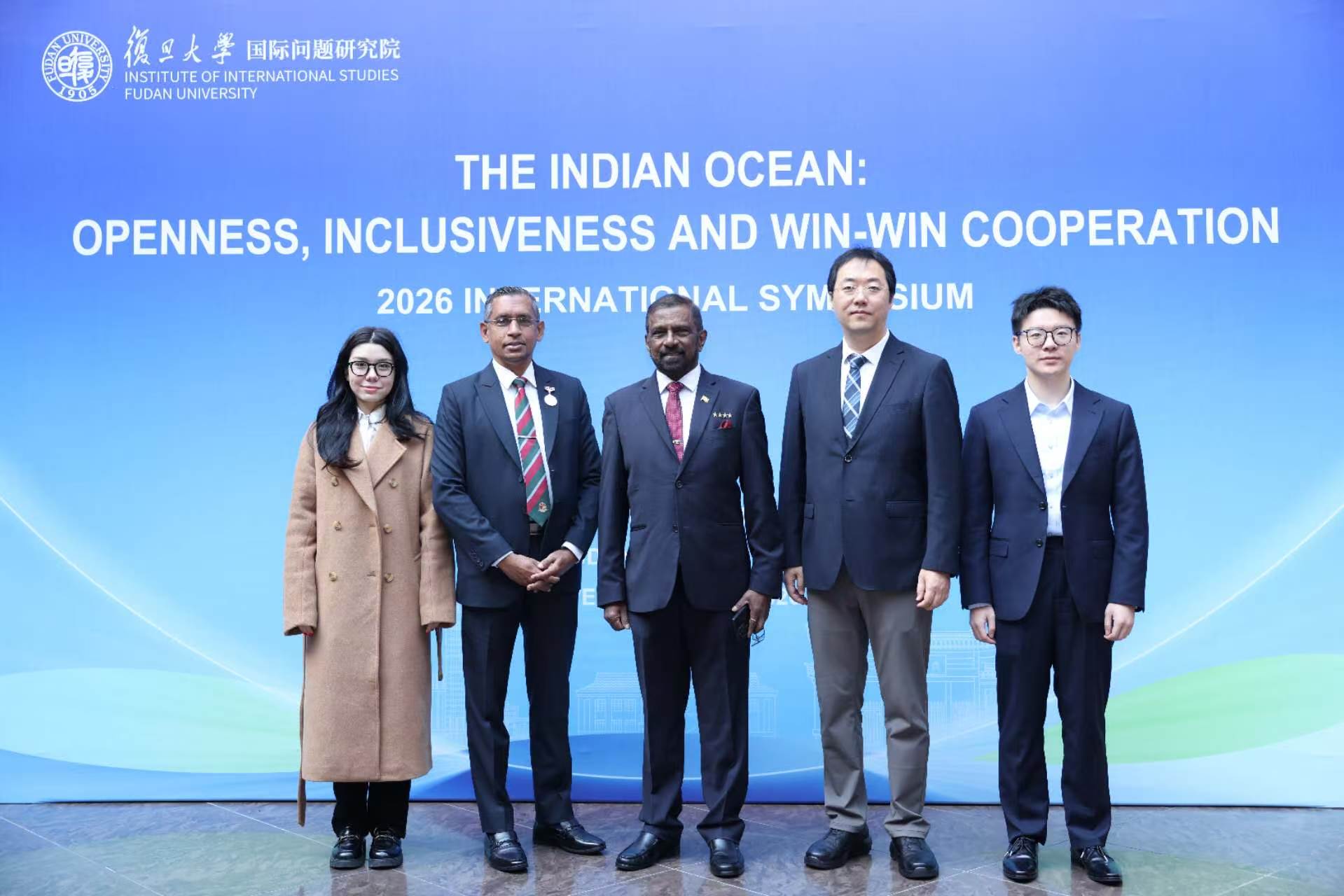
Admiral Prof. Jayanath Colombage, a Non-resident Senior Fellow of Hong Kong Research Center for Asian Studies, presented a paper titled “The Indian Ocean at a Crossroads: Emerging Hotspots, Great Power Rivalry and Conflict Management”. The central argument of this paper was, The Indian Ocean must remain an ocean of cooperation rather than confrontation, connectivity rather than containment, and shared prosperity rather than geopolitical division. However, achieving this objective is becoming increasingly challenging.
Admiral opined that, for centuries, the Indian Ocean has been an ocean of connectivity, commerce and civilisational exchanges. Today, the Indian Ocean remains indispensable to global economic prosperity. It connects the energy-producing regions of the Persian Gulf with major manufacturing and consumption centres in Asia. It provides critical maritime connections between Europe, Africa, the Middle East and the Indo-Pacific. The Strait of Hormuz, Bab el-Mandeb and Strait of Malacca are among the world's most strategically important maritime chokepoints. Any major disruption to these maritime passages has consequences far beyond the Indian Ocean itself. Yet, the strategic character of this ocean is changing. We are witnessing increasing naval deployments, expanding military partnerships, strategic competition over ports and maritime infrastructure, and the growing involvement of external powers. The Indian Ocean is becoming an important theatre of global geopolitical competition.
There are emergence of interconnected maritime hotspots across the wider Indian Ocean, such as Persian Gulf and Strait of Hormuz, Red Sea. Gulf of Eden and Bab-El-Mended, Iran, Somalia, Afghanistan and India-Pakistan border in the western Indian Ocean and Myanmar in the Bay of Bengal. Shipping companies have, at various times, diverted vessels around the Cape of Good Hope, increasing voyage distances, transportation costs and delivery times. The reality is that a conflict involving relatively limited geographical areas can disrupt global supply chains. These challenges cannot be addressed through naval power alone. They require regional intelligence cooperation, effective maritime law enforcement, stronger coastal-state capabilities and coordinated responses.
Concluding his speech Admiral stated that The Indian Ocean is entering a period of profound strategic transformation. Emerging hotspots, great power competition and technological disruption are creating new risks for regional and global stability. Military superiority alone cannot guarantee maritime security. Sustainable stability requires diplomacy, international law, confidence-building measures, regional institutions and cooperation among both major and smaller states.
The future of the Indian Ocean should not be determined solely by the strategic calculations of major powers. The voices and interests of its littoral and island states must be central to shaping the emerging maritime order. We must avoid allowing strategic competition to transform this shared maritime space into a theatre of confrontation. Instead, we should work towards an Indian Ocean where economic connectivity is encouraged, legitimate security concerns are respected, disputes are managed peacefully and development opportunities are shared. The real choice is between confrontation and cooperation, exclusion and inclusiveness, and geopolitical rivalry and shared prosperity.
For Sri Lanka, and indeed for many smaller Indian Ocean states, the preferred future is clear. We seek an Indian Ocean that is peaceful, open, inclusive, economically vibrant and governed by international law. An ocean where great powers compete responsibly but cooperate wherever possible. An ocean where smaller states retain their strategic autonomy. And an ocean where security is understood not merely as the absence of war, but as the presence of stability, connectivity, resilience and shared prosperity.