Admiral Jayanath Colombage Participated in Pathfinder Foundation Conference
Time: 2026-11-11 Author: RCAS
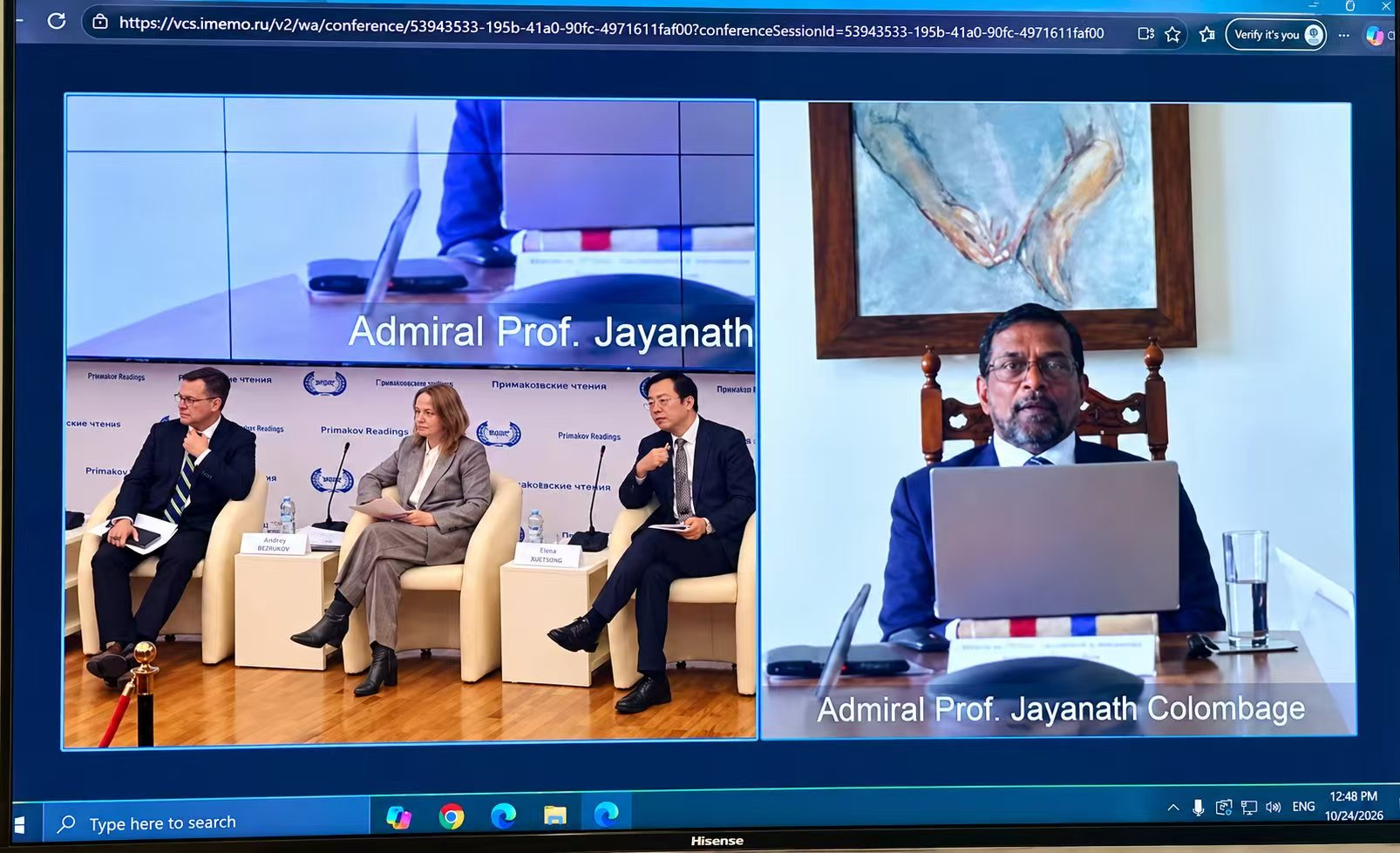
The Pathfinder Foundation joined international conference organized by the Primakov National Research Institute of World Economy and International Relations, and Russian Academy of Sciences to discuss “The Greater Indian Ocean: Points of Growth and Tension” held in Moscow Russia on 26th October 2026.
The conference's objective was to analyze the main trends and directions within the global changes underway in world politics and economics, the transformations taking place in the countries of the Greater Indian Ocean, the contradictions among the beneficiaries of these processes, those adversely affected by them, and the elites, as well as their strategies of struggle and interaction, and to attempt to forecast where these contradictions may lead the societies of the macro-region.
Admiral Prof. Jayanath Colombage, a distinguished fellow of Pathfinder Foundation and Non-resident Senior Fellow of Hong Kong Research Center for Asian Studies delivered a talk titled “Global Transformations and the Future of the Greater Indian Ocean: Sri Lankan Perspective” during the plenary session of this international conference.
Admiral stated that we are living through an extraordinary period of global transformation. The international political and economic order that emerged after the Cold War is undergoing significant changes. The distribution of global power is shifting, economic globalization is being reconfigured, technological innovations are transforming societies, and geopolitical competition is increasingly influencing national development choices.
These transformations are particularly consequential for the Greater Indian Ocean region, which connects Africa, the Middle East, South Asia, Southeast Asia and Australia. The Indian Ocean is not merely a geographical space. It is a civilizational crossroads, an economic lifeline, and an arena of geopolitical competition. For Sri Lanka, an island nation strategically located close to major East–West maritime trade routes, these transformations create both opportunities and vulnerabilities.
Admiral highlighted that the competing powers offer investment, infrastructure, technology, market access and development assistance. On the other, growing strategic rivalry can generate political pressure, economic dependencies and difficult foreign-policy choices. The central challenge is therefore not simply how smaller states should respond to major-power competition, but how they can transform geopolitical interest into sustainable national development without sacrificing strategic autonomy.
The Indian Ocean should not become a dividing line between competing geopolitical blocs. It should remain an ocean of connectivity, cooperation and shared prosperity. Sri Lanka offers a case study of the relationship between global transformations, domestic economic policies and social consequences.
Admiral Colombage concluded the talk by stating that the future development of the Greater Indian Ocean should be guided by economic resilience, social inclusion and cooperative regionalism. Indian Ocean countries should strengthen economic connectivity, maritime cooperation, environmental protection and institutional dialogue without allowing geopolitical rivalries to dominate regional development.