

Admiral Jayanath Colombage Participated in First International Symposium on Global Islands
Time: 2026-11-11 Author: RCAS
Zhejiang Ocean University in Zhoushan, China conducted a two-day symposium titled “First International Symposium on Global Islands”-Challenges and Resilience: Sustainable development and Cultural Dimensions of Global Islands, from 6th to 8th November 2026. The symposium was held at the Teachers College of Zhejiang Ocean University.
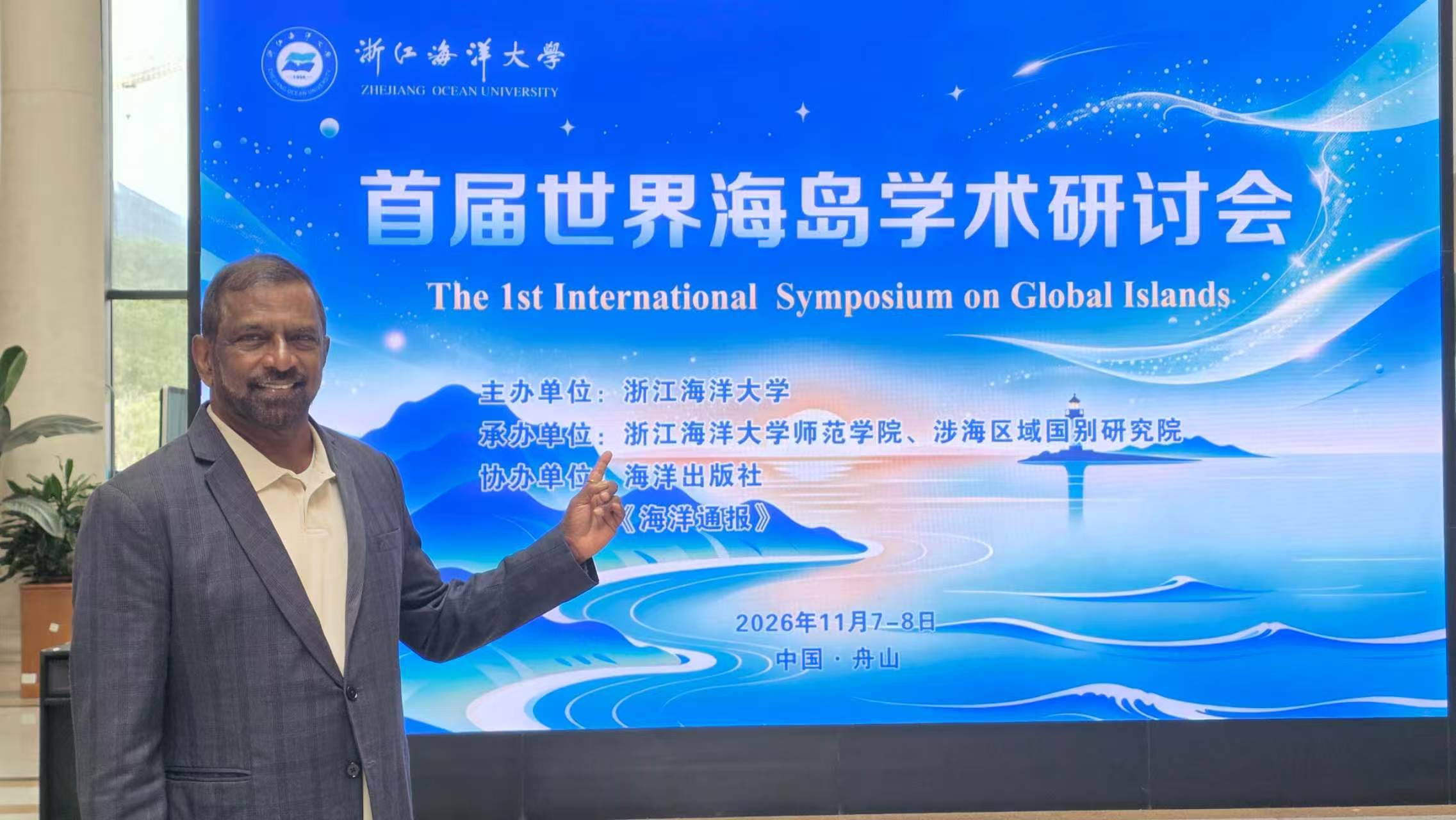
This Symposium aimed to bring together researchers, scholars, and practitioners to share knowledge, exchange ideas, and strengthen collaborations in the field of island studies and sustainable development. Islands, as unique geographic units connecting land and sea, serve as “micro-laboratories” for human civilization and as key sites for observing the tension between globalization and local particularities. The Symposium included keynote speeches, parallel sessions, and a high-level roundtable focusing on ecological challenges, cultural heritage, and interdisciplinary approaches for island governance and sustainability.
Admiral Prof. Jayanath Colombage, Non-resident Senior Fellow of Hong Kong Research Center for Asian Studies was the main speaker at the round table conference and presented a paper titled “Island States in a Changing Global Order: Maritime Security, Sustainable Development and Strategic Autonomy—A Sri Lankan Perspective”. Admiral Colombage highlighted that Island states occupy a distinctive position in the contemporary international system. Their geographical characteristics create opportunities for maritime connectivity, international trade, ocean-based economic development and cultural exchange, while simultaneously exposing them to environmental vulnerabilities, external economic shocks and geopolitical competition. As the global order undergoes significant transformations driven by the rise of Asia, major-power rivalry, technological innovation and climate change, island states must reconsider conventional approaches to security, development and international engagement.
Admiral’s paper examined the interconnected challenges of maritime security, sustainable development and strategic autonomy from the perspective of Sri Lanka, a strategically located island state in the Indian Ocean. It argues that geographical location alone does not guarantee prosperity or security. Instead, island states must develop institutional resilience, diversified economies, effective ocean governance and balanced foreign relations to transform geographical advantages into sustainable national development.
Drawing on Sri Lanka's historical maritime connectivity, contemporary geopolitical environment and economic experiences, the paper examined the implications of major-power competition, blue-economy development, climate change, maritime security threats and technological transformation. Particular attention is given to the importance of strategic autonomy for smaller states seeking to maintain constructive relations with competing powers without compromising national sovereignty.
The paper proposed an integrated framework for island governance based on maritime security cooperation, environmental sustainability, economic diversification, institutional coordination and knowledge partnerships. It concludes that island states should be understood not merely as vulnerable geographical entities but as active contributors to regional stability, sustainable ocean governance and international cooperation.
Admiral Colombage’s paper gave rise to a detailed and lengthy discussion about best practices and lessons learnt from Sri Lankan experience in this challenging geo-political, geo-economic and environment sensitive world with special emphasis on Island states.