
Dr. Sujit Kumar Datta Participated in the International Conference in India
Time: 2026-02-22 Author: RCAS
Dr. Sujit Kumar Datta, Former Chairman of the Department of International Relations, University of Chittagong, Bangladesh, and Director of the Hong Kong Research Center for Asian Studies-Bangladesh Center (RCASBC) attended the International Conference on the same topic, "Decolonising a Discipline: India Civilisational Insights to a Global IR", at the Department of Political Science, Aligarh Muslim University (AMU), India, between 14 and 16 February 2026.
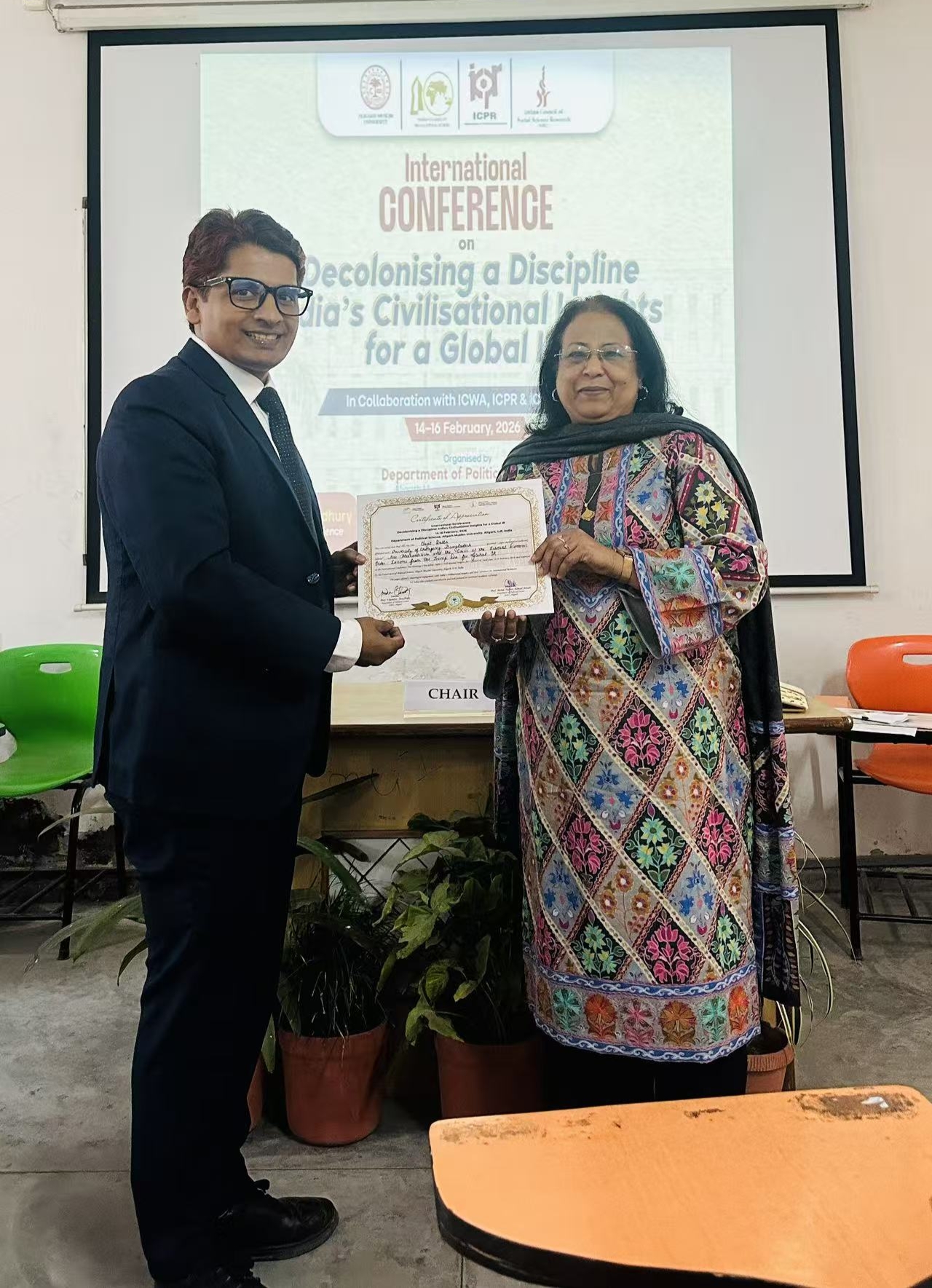
The conference invited scholars, researchers, and students of India and beyond to deliberate on one of the most burning intellectual projects of our time, the re-evaluation of International Relations (IR) on Eurocentric grounds. We have been socialized to appreciate our intellectual heritage, and it can only be justified by a Western shadow. This Comparative Trap has introduced Kautilya, the Indian Machiavelli, or Kalidasa, the Indian Shakespeare—a disease of language that speaks too avowedly to lead us to think that our men of thought are anything but regional forms of a universal Western species. This was the psychology inherited that was hurled into the battle by the conference.
One of the recent critical themes of the conference was also the critique of the Comparative Trap. The speakers stressed that Indian intellectual traditions are usually perceived through Western analogies and are not discussed on their own terms. Kautilya is not the Machiavelli of the South Asian subcontinent; his Arthashastra is a creation of a certain civilisation with its metaphysical, ethical, and strategic foundations. The literary genius of Kalidasa requires no Shakespearean analogy to its validity.
And this is no idle intellectual vice. It reveals a higher degree of epistemic privilege, placing Western thought as the universal and non-Western thought as the particular. The conference further assumed that this hierarchy has to be decolonised by the IR, not only the reading lists. Even in the Indian state, it is often reduced to a textbook Westphalian nation-state established in 1947. What this perspective fails to realise is that India is a long historical civilisational unit with thousands of years of political stability, philosophical discourse, and traditions of governance. The present-day republic was not simply the by-product of the decolonisation process but the restoration of a very ancient historical memory.
The participants have emphasized that Eurocentrism is not only a curriculum but also a psychology inherited. It determines how we perceive power, order, sovereignty, and even the nature of human beings. Western IR theory is predicated on a Cartesian dualism of mind and body and on rational calculation as the preserve of neither the ethical nor the spiritual. In relative terms, the Indian philosophies put across the conception of Annamaya Purusha- a profound psychosomatic awareness which states: we eat what we know, we drink what we know, we think what we know. Knowledge is not conceived as disinterested knowledge, but as represented and moral. This idea is a critique of the extreme materialism-moralism dichotomy that prevails in much of the IR mainstream.
Similar to the prevalent IR theory, which identifies the absence of a global hegemon as anarchy, bound to lead to conflict, the Indian civilisational lens, in turn, identifies Dharmaglani as an agent of disorder, i.e., ethical breakdown. Not only is it not disorganization, but the absence of Dharma. This change in the situation of the discussion goes beyond structural inevitability to a moral responsibility.
The tendency in support of Global IR during the past few years has made tremendous moves to listen to the voices of the non-Western. These successes were realised at the conference, but in quite an open way, they were perceived as restricted. More often than not, Global IR remains a pluralist practice-a collection of regional opinions that are permitted to participate in the discursive arena of disciplinarity but remain subjected to address a pre-existing set of Anglo-American language.
One of the keynote speakers made a very great point when he stated that we are welcome to the table, but we cannot redesign the room. Further evolution of IR, which was proposed at the conference, was the transition to the so-called Civilisational IR. This framework is not oriented to inclusion, but rather to re-centring. It transcends the integration of Indian instances into Western theories and makes Indian and other civilisational ethics the main source for cognising the universal order. Civilisational IR is not averse to dialogue. Rather, it targets a real plurality in which Western realism, liberalism, and constructivism are debated on equal footing with Dharma-based morality, ontologies of relations, and holistic epistemologies. It is an appeal to the intellectual autonomy of intellectual co-operation.
The conference had 32 topic panels on different aspects, which included:
● Asia Before The West: Civilisational Orders And World Politics.
● The West: Realism and Comparative Traditions of Power.
● Mainstream IR Theories of Indian Relations.
● Gender And Feminist Rethinking of the Global Ir.
● Beyond Western Knowledge: What other Knowledges Would Like?
● Beyond Westphalia - Sovereignty, Statehood And Order.
● Non-Alignment And Independent Strategy.
● In these boards, scholars were engaged in
The controversies were not limited to abstract theorizing but also addressed contemporary problems of the world, i.e., climate change, multipolarity, technological governance, and the crisis of the liberal order, which were also formulated using a civilisational approach. The intellectual environment was diverse, thanks to the participation of senior professors and doctoral researchers. It is worth noting that students were not sitting down and listening. We were encouraged to demand, criticize, and re-examine the discipline.
The size and seriousness of the conference dictated the academic process. One of the proposals, 251 proposals, of which 100 papers were initially picked after going through three or four rounds of peer review. This was rigorous, putting the scholarship to the test in terms of quality and intellectual depth. The other significant announcement of the valedictory session was the fact that Routledge had accepted a series of textbooks on the conference subjects. These textbooks target the undergraduate and postgraduate students; it is a definite shift in conference to curriculum. This development shows that the movement is structural but not symbolic. Decolonising IR is moving panel discourses towards pedagogical change.
Curricular reform was identified as one of the conference's brightest outcomes. This desire could be explained as From Conference to Curriculum. This is to ensure that the inquiry into Indian civilisational thought will not remain a discriminatory topic for prospective students, but will be a component of the standard theory of IR. Curriculum Committees were discussing special courses in Civilisational IR, restructured theory courses that brought together Western and Indian philosophers in dialogue, and the inclusion of primary Sanskrit, Persian, and regional literature in the curriculum. In my case, this is groundbreaking for the researcher. This means that future generations will not become intellectually displaced in their respective classes.
Being present at this conference made me take some time to reflect on the kind of academic training I have received. But how often have I read Hobbes, or Locke, and Waltz, without some no less familiarity with Kautilya, or with Shantideva, or with Abhinavagupta? How many times have I accepted as a matter of course some such structural condition as anarchy without questioning its metaphysical presupposition? The conference did not advocate replacing Western thinkers with Indian ones. Rather, it provoked us to engage in the process of intellectual decolonisation, which is internal and involves the realisation that knowledge has not been possessed by a single civilisation. It also instructed us on the equality between intellectual and political sovereignty. A multipolar world requires multipolar thinking.
The Aligarh Muslim University International Conference on the topic Decolonising a Discipline: India's civilisation insights to global IR was not only an academic conference, but also a move in the ongoing reconsideration of International Relations. The conference planted the seeds of a paradigm shift through its opposition to the Comparative Trap and its criticism of Eurocentric psychology, and implied the form of Civilisational IR.
With 100 papers undergoing rigorous examination, 32 thematic spaces, and a prospective sequence of books available with Routledge, the program aims to change not only academic discourse but also classroom instruction. This conference was a source of intellectual light and moral strength to those who study Political Science and International Relations. It determined our civilisational tradition not to be a byword for the world, but to have universal knowledge. Should the globalisation of Western IR take place in the 20 th century, the 21 st century could also be marked by the re-centrism of the discipline towards a civilisational form. And in that metamorphosis of his, in which such conferences as this will be remembered, it will not be remembered as something accidental, but as a ground of transition in the history of thought.