

Admiral Jayanath Colombage Participated in the 4th Indian Ocean Security Conference
Time: 2026-02-21 Author: RCAS
The Pathfinder Foundation, a policy-based think tank in Colombo, Sri Lanka conducted the 4th Indian Ocean Security Conference in Colombo on 17th and 18th February 2026. This biennial conference brought together policymakers, scholars, and practitioners from the Indian Ocean littorals, major maritime states, and members of the international organizations to exchange views on geopolitical, security, and economic dynamics in the Indian Ocean Region.
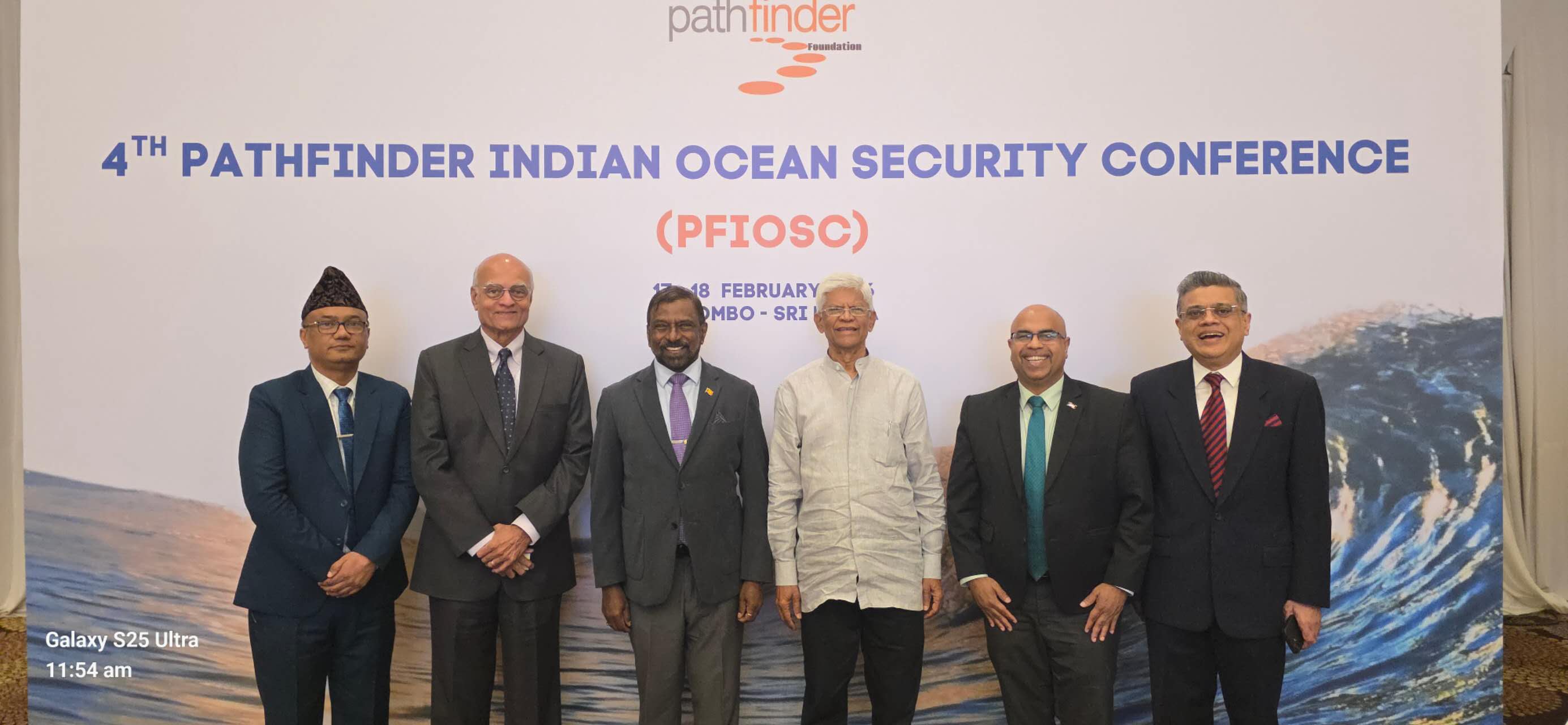
The event was co-chaired by Chairman of Pathfinder Foundation Ambassador Bernard Goonetilleke and former national security adviser, foreign secretary of India, Ambassador Shivshankar Menon. The keynote address was delivered by former Assistant Chief Cabinet Secretary to Prime Minister Shinzo Abe, Professor Nobukatsu Kanehara, professor of Reitaku University in Japan.
This conference focused on four major themes: Connectivity Corridors in Competition: BRI, IMEC and beyond, Seabed Minerals: Strategic Competition and Security Implications for the Indian Ocean, Digital Maritime Silk Route: Submarine Cables, Data Security, and Tech Rivalry, and, Climate Change, Migration, and Human Security in the Indian Ocean.
Admiral Prof. Colombage, nonresident senior fellow of the Hong Kong Research Center for Asian Studies (RCAS) presented a paper titled “Digital Maritime Silk Roads: Submarine Cables, Data Security, and Tech Rivalry in the Indian Ocean: Critical Undersea Infrastructure as a New frontier of Geostrategic Competition”. Admiral presented that beneath these same sea lanes which carries global trade and energy lies the physical backbone of the global digital economy ‘submarine fibre-optic cables’. In the Indo-Pacific’s evolving strategic landscape, the contest for digital dominance is playing out also beneath the sea. As states seek to control information flows and assert influence in the digital domain, these cables have emerged as strategic targets. Control over these digital arteries is increasingly viewed as a strategic advantage. The system’s physical fragility—where a single severed cable can disrupt millions of lives—starkly contrasts its critical importance. A growing concern in this strategic landscape is the potential for seabed warfare, in particular, the weaponization of seabed assets.
Admiral Colombage further stated that every day, multi-billion-dollar worth of trade passes through the routes of the Indo-Pacific via subsea cables. This has caused a growing worldwide concern over the protection of subsea cables in the Indian Ocean. The Indo-Pacific region has gained economic and political momentum in the last few years, and this further validates the concern to protect data transmission worldwide.
He highlighted that the China’s Digital Silk Road, launched as part of the broader Belt and Road Initiative, seeks to shape the global digital ecosystem through investments in: Telecommunications networks, Data centers and cloud services, Smart ports and cities, And submarine cables. In the Indian Ocean region, Chinese firms—often have been involved in the construction, financing, or maintenance of undersea cable systems and landing infrastructure.
The Digital Silk Road serves several objectives: Reducing dependence on Western-centric networks, Exporting Chinese technical standards and governance models, including approaches to cybersecurity and data management. Embedding Chinese firms into the long-term digital infrastructure of emerging markets. From the perspective of host countries, these projects often promise faster connectivity, lower costs, and access to capital that Western providers have historically been reluctant to offer.
Admiral Colombage spoke about the broader ‘Digital Ecosystem’. It is important to stress that submarine cables are only one layer of the digital maritime ecosystem. They interact with: Data centers and cloud infrastructure, Satellite systems and hybrid networks, Smart ports, logistics platforms, and maritime surveillance technologies. The competition, therefore, is not just about cables on the seabed. It is about end-to-end digital ecosystems, from physical infrastructure to software standards and governance norms. This is why the debate increasingly overlaps with discussions about: Artificial intelligence, Cybersecurity, and digital public infrastructure.
Admiral highlighted the threats to submarine cables-natural and deliberate, and discussed the international law governing Subsea cables. The 1982 United Nations Convention on the Law of the Sea (UNCLOS) updated the script by affirming the right to lay and maintain cables in exclusive economic zones (EEZ) and on the high seas, while obliging flag States to police vessels flying their flag (Art. 94), punish wilful damage (Art. 113), and exercise penal jurisdiction over maritime incidents, including cable damage (Art. 97). UNCLOS was a considerable advance—but it still framed cables as commercial convenience, not strategic terrain. Some of the areas of international law which can be used to take the perpetrators of intentional cable damage are:
Objective Territoriality- To consider the effects of offshore damage manifest within their own territory.
Enforcement Jurisdiction- The power to stop, board and detain suspected ships
Constructive Presence- Rooted in maritime criminal law for coastal states to assert jurisdiction over foreign vessels deliberately damaging submarine cables.
Fostering Common Interpretations- Common idea among like-minder nations.
Interpreting Cable damage as an act of Piracy- To interpret cable damage as an act of piracy in accordance with the international law.
It is a multilateral world no country can unilaterally pass laws relating to something that concerns everyone. Submarine cables in the Indian Ocean Region not only affect Indian Ocean littorals but also affect the functioning and economy of related entities. Multilateral problems need multilateral solutions. It is time that an example is set by the international community that cooperation is not an impossibility, and the trailblazer of this example can be the ratification of common laws in international waters for the protection of data links that run the world.