

Can America's Midterm Elections Shift the Balance of Power in Asia
Time: 2026-11-11 Author: Sujit Kumar Datta
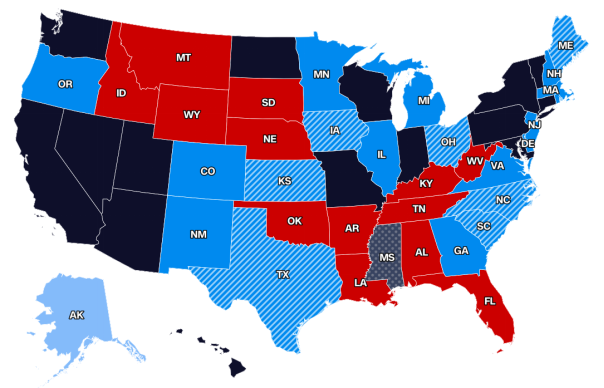
America's midterm elections on Nov. 3, 2026, have made a strong political statement from Washington to the world. The Democrats have taken a big step to end unified Republican rule in Congress, and President Donald Trump is facing a significant blow.
▲CNN.
This creates a new era of bipartisan government that could have important consequences for U.S. foreign policy. Whether this shift in political winds will positively or negatively affect the Indo-Pacific strategic picture is key in Asia, particularly amid increased competition between the U.S. and China and heightened security concerns and uncertainty in Washington over international commitments.
The short answer is no: the midterm elections will not change the basic contours of America's strategic objectives in Asia, but they will change the political factors shaping how America pursues them. Military might, economic ties, technological rivalry, diplomatic ties and the credibility of Asian great powers shape the balance of power in Asia.
However, a change in control of Congress alone will not alter the dynamics. It could affect the resources and consistency the United States has in engaging the region, and it could change the political legitimacy with which the United States engages the region.
A new political constraint on the White House
One stronger outcome of the Democratic victory is a stronger Congress that can hold the Trump White House accountable. Congress has significant power to influence federal spending, legislation, oversight and high-ranking official confirmations.
Democratic control of both houses could also make it harder for the White House to advance its domestic agenda and to review its foreign and security policies. But it is a dangerous illusion to think the election has shifted control of foreign policy from the president to Congress. The president has broad constitutional and executive powers in diplomacy, military affairs and certain areas of trade policy.
The new majority in Congress can investigate, question, slow funds for administration initiatives, and challenge administration decisions, but it doesn't automatically establish a new Indo-Pacific strategy. That would make it more likely to create political "tension" and a policy shift rather than an immediate strategic shift.
The China question: competition or recalibration?
No matter who controls Congress, America's policy on Asia will continue to focus on China. It's not just Washington versus Beijing; it's President Washington versus President Beijing. It includes cutting-edge technologies, artificial intelligence, semiconductors, maritime security, trade and investment, supply chains, and influence in regional institutions.
Politically, Washington broadly agrees it must remain competitive with China. The election results should not be seen as a call to believe that a dramatic shift in US–China relations is imminent. Instead, it could lead to more questions being asked by Congress on how the administration is handling Chinese policy. New topics to be debated will include tariffs, technological barriers and investment screening and strategic cooperation with allies. Washington will find it hard to strike the right balance between strategic competition and uncontested confrontation.
Implications for the Indo-Pacific security architecture
The Indo-Pacific is likely to remain a strategic battleground for the United States. Washington's security and economic relations with Japan, South Korea, Australia, the Philippines and India are long-term in nature.
The Quad and AUKUS are examples of American efforts to strengthen regional alliances, keep the region stable and ensure a favourable balance of power. The outcome of the midterm might be factored into the national political debate regarding military spending, military assistance and military alliance obligations. Congressional oversight might help ensure more openness on the expenses and goals of the American security operations. Meanwhile, the administration could struggle to build agreement on some budget priorities.
Trade, technology and economic uncertainty
The effects of the midterm elections may be as strong in trade and investment as they are in security issues in some Asian countries. Some local manufacturers and investors in the region are unsure about the future because of Trump's tariff plans. But a Democratic Congress can provide more oversight and scrutiny of trade and economic policy; that doesn't mean the president won't have more control over tariffs.
Although the US-China trade war is no longer a factor, it will remain a factor in the Asian supply chain. Rising diversification of production networks provides opportunities for countries like Vietnam, Malaysia, Indonesia, Thailand and Bangladesh to attract investment.
However, these opportunities also carry risks. Smaller economies could be pressured to conform to alternative economic systems if Washington and Beijing step up pressure on technology, trade and investment. Technology is a very important element. The race for AI, semiconductors, digital infrastructure and new technologies is becoming tied to national security. How Asian countries bridge these technological gaps will play a crucial role in the region's future, as will how they navigate the balancing act of development between their own interests and those of their neighbors.
South Asia and the strategic choices of smaller states
South Asia plays a significant role in the Indo-Pacific region because of its maritime geography, economic potential and strategic relations with major powers. India will remain a key U.S. partner in balancing against China and stay as strategically independent as possible in the process. A change in the makeup of the US Congress may affect the content of the US-India relationship, but the strategic convergence is unlikely to disappear.
The political upheaval in Washington should be a special concern for Bangladesh. Bangladesh, at the northern tip of the Bay of Bengal, is increasingly playing a strategic role in the region's connectivity, security and Indo-Pacific geopolitics. Specifically, strong relations with the U.S., China, India, Japan, and the European Union are critical to its economic development and foreign-policy deliberations.
A more polarized Washington might not be so sure about trade preferences, investment, development cooperation and U.S. engagement in Bangladesh in the future. In the meantime, Bangladesh may also explore investment options, create export markets and improve its regional value chain.
But Dhaka's hope that any Congress run by the Democrats will inevitably result in more benign American policies is wrong. The Bay of Bengal is a peculiar situation. Maritime security, port development, blue economy programmes, energy links and regional trade are now tied to Indo-Pacific competition. Bangladesh should leverage its geographical advantage to facilitate cooperation and not major powers' rivalry. Its foreign policy should be based on strengthening the nation's capacities, economy and peaceful active presence in the region.
The limits of electoral change
One of the most important lessons from the mid-term elections of 2026 is that domestic political shifts in key countries have repercussions worldwide. But electoral shifts aren't always strategic shifts. The U.S. has longstanding interests in accessing markets in Asia, protecting shipping lanes, strengthening regional ties and competing with China.
These interests will presumably remain regardless of who holds the majority in Congress or who is in office. The more pressing question, of course, is how Washington will advance those interests. The Democrats' congressional victory might lead to more oversight of executive action, more friction and conflict in Congress over policy issues and less consensus on priorities.
It could also force a reevaluation of the cost of the United States' international obligations in the economic and diplomatic areas. Analysts have also pointed out that it may lead to caution in some aspects of US policy, rather than a change in its regional strategic course.
In the final analysis, no single election in the United States will determine the balance of power in Asia. It will depend on economic strength, technological capability and military modernization, diplomacy and regional cooperation. America's midterm elections could alter aspects of its internal political dynamics that, in turn, will shape its ability to continue implementing its Asian strategy.
Still, they will not change the trajectory of the Indo-Pacific's evolution. America's midterm elections may change the political calculations in Washington. Whether they reshape the balance of power in Asia will depend on how the U.S., China and regional actors respond to the new political reality.
The future of Asia won't be decided by who has the majority in Congress in Washington; it will depend on who can offer Asia a more credible, stable and mutually productive vision of its future.
This article was first published at Asian Review, Nov.10, 2026, https://www.asianreviewnews.com/can-americas-midterm-elections-shift-the-balance-of-power-in-asia/.
 <RCAS Commentary-Can America’s Midterm Elections Shift the Balance of Power in Asia>