

The Crisis of Credibility in Nuclear Deterrence
Time: 2026-04-15 Author: Sujit Kumar Datta
One of the simplest, but efficient, assumptions that the nuclear deterrence theory has always been based on is that nuclear weapons (or even the alleged possession of nuclear weapons) will prevent war. This argument guided international security during the Cold War and after, not only by ensuring that the great powers remained stable and maintained their strategies, but also by avoiding confrontation. Nonetheless, the Iran crisis today is becoming a chilling reality: the concept of nuclear deterrence is no longer as real, efficient, or widespread as it has been believed to be. The new war demonstrates the ineffectiveness of deterrence and, at the same time, points to a deeper crisis of belief in its logic.
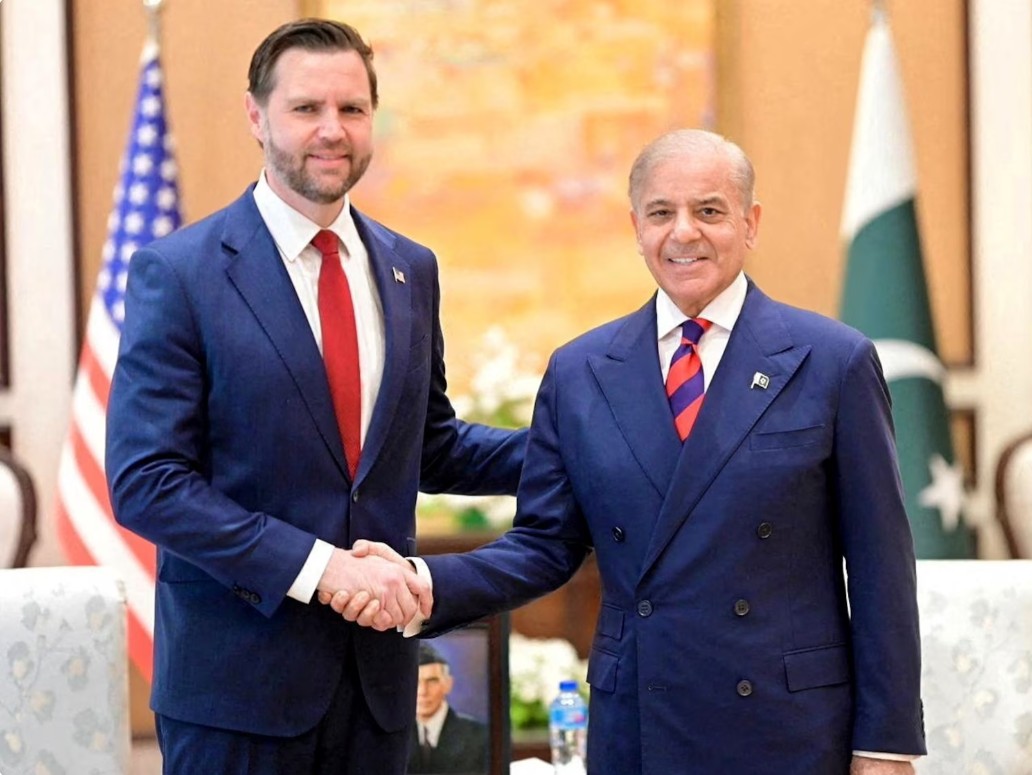
▲Pakistan’s Prime Minister Shehbaz Sharif shakes hands with U.S. Vice President JD Vance during their meeting, on the day delegations from the United States and Iran are to hold peace talks, in Islamabad, Pakistan, April 11, 2026. Pakistan’s Prime Minister Office via Reuters.
According to the Realist approach, deterrence works based on rational calculation. The selfish interests of states are not to do things that will attract unwanted retaliation. Iran’s experience, however, has demonstrated that deterrence is on the wane in a more asymmetric world that is ideologically driven and whose perceptions of risk are evolving. The United States and Israel still resorted to direct military attacks even though Iran had amassed enriched uranium and its much-touted nuclear latency. It means that Iran’s deterrent posture, which relied on ambiguity and potential capabilities, was insufficient to deter coercion. Indeed, the recent reviews concluded that Iran had still been left with the massive nuclear facilities even after they attacked them multiple times. But these skills were not able to stop the external intrusion. Instead, they had been included on the list of reasons to do so. This quandary lies at the heart of the deterrence issue: instead of deterring war, nuclear latency may prompt immediate action.
The recent failure of U.S.-Iran negotiations is just another example of the ineffectiveness of deterrence. The negotiations were said to have failed due to the reluctance of Iran to give up on its nuclear programme, and the United States demanded tough conditions that they would not weaponise them. The following was not in any way stable, but the stalemate and threats were continuing to mount, and the economic upheaval was leading to a truce at arms’ length. In this instance, a balance was not achieved, and a stalemate was reached through deterrence.
The U.S. commitments have been undermined in terms of credibility. Allies identified with Washington’s actions and did not even want to be part of the war. Such disintegration sends a message to adversaries that the coalition might not support American deterrence threats. Deterrence is not just about weapons but also about alliances, signalling, and determination. And, where these are weak, then there is weak deterrence. Threats have been watered down through overuse and haphazardness. The U.S. was demanding maximalist terms and said it was prepared to negotiate. This kind of conflicting message undermines the effectiveness of deterrence. The deterrence environment has changed due to operational and technological developments. Iran can sustain underground resources, decentralise resources, and cope with asymmetries such as the Strait of Hormuz, implying it cannot be easily destabilised any longer. This kind of environment is not as conducive to more traditional forms of deterrence and restraint, as direct retaliatory targets are present. In liberal terms, the crisis indicates the loss of international norms and institutions that previously helped maintain deterrence stability. Diplomatic structures, arms control accords and verification regimes have been undermined. Failure of the negotiations and unilateral military intervention are signs of a dwindling interest in multilateral solutions.
The example of Iran illustrates how this destruction of trust, which underpins deterrence, is achieved. The Iranian leadership has repeatedly claimed that previous agreements have not delivered the promised benefits, making it even less willing to compromise. On the other hand, the nuclear ambitions of Iran are seen as destabilising to the United States. This mistrust leads to a security dilemma in which each side feels threatened by the other and thus sees the other as a threat to its defence. Additionally, deterrence is made more complex because international institutions, such as the non-proliferation regime, are being eroded. The selective application or non-application of rules can bring states to the point where nuclear competence is the only certain way to survive. But, ironically, even this is questionable, as the Iran crisis suggests.
The overall effects are very extensive. Nuclear deterrence was even considered the best equaliser of all, enabling weaker states to deter stronger ones. In the modern, multipolar, technologically sophisticated world, however, deterrence is becoming increasingly conditional. It is not based solely on the weapons, but also on the perception, credibility, and context. Perception has been a determining factor. Every stakeholder desired to make their own story of victory and power in the Iran war. Iran placed its existence and its continuing capability to create nuclear energy as a show of strength. The US emphasised the tactical success and downplayed strategic failure. The main difference indicated by these warring stories is that deterrence is no longer mainly about preventing war, but about controlling perceptions of the course and consequences of war.
The result of this change is a very significant question: if deterrence can be ineffective in preventing war and cannot be employed to guarantee victory, why should it be employed? The first solution, deterrence, is still relevant, albeit in a new form. It is no longer possible to deter conflict, but it can be viewed as an escalation-controlling mechanism. The fact that nuclear weapons have never been deployed in the Iran crisis, yet there has been a lot of hostilities, implies that deterrence has not lost its restraining force. However, this deterrence is far less potent and inferior to that envisioned during the Cold War. It operates in situations of uncertainty, misperception, and rapid technological change. It also becomes more prone to failure, as errors or incorrect calculations can easily escalate crises.
To sum up, during the Iranian crisis, there was a paradigm shift in deterrence. The classical theory of rational actors, discretionary threats, and enduring alliances is not as palatable. Rather, it possesses a more complex, less predictable, conditional and inefficient deterrence system.
This will also involve the policymakers re-strategising their strategic priorities. The use of nuclear deterrence is inadequate. Diplomacy, conflict management and regional security structures should be given more emphasis. This trust in international institutions and norms needs to be restored as well.
The theorists ought to be able to synthesise the crisis theory. Power, institutions, credibility and perception are accentuated by Realism, Liberalism, and Strategic Studies, respectively. These two views can only be combined to enable us to understand the nature of deterrence, which is changing so rapidly.
Nuclear deterrence is not just a hypothetical; it is a reality with worldwide impacts. It is also becoming a new age where nuclear weapons may no longer be relied upon to keep the world safe, and the deterrence rationale may need to be reexamined at an extreme scale, as it is proving to be the case in the Iran war.
This article was first published at Times of Bangladesh, Bangladesh, April 14, 2026,
https://tob.news/the-crisis-of-credibility-in-nuclear-deterrence/.
