Mother Of All Deals: India-EU's Strategic Decoupling from Trade Coercion
Time: 2026-02-15 Author: Sujit Kumar Datta
January 27, 2026, will be remembered in the history of the economy as the day when the Mother of all Deals has finally crossed the finish line. Two decades of ups and downs, talks, stagings, and cold-blooded diplomatic talks have finally been resolved with the official India-European Union (EU) Free Trade Agreement (FTA). So long as the pens are being girded to sign on formally after legal examination, the message that New Delhi and Brussels have sent over is so thunderous: in an age of trade as a weapon, the greatest democracies of the world are choosing to go strategic in their interdependence rather than imposed in their isolation. It does not only represent a collection of tariff booklets but a political insurance policy. This FTA is also a guide to the multi-polar world order in a stronger form, in an era where trade coercion has become a new weapon in the great power game, with the most recent example being the Greenland issue wrangling across the Atlantic.
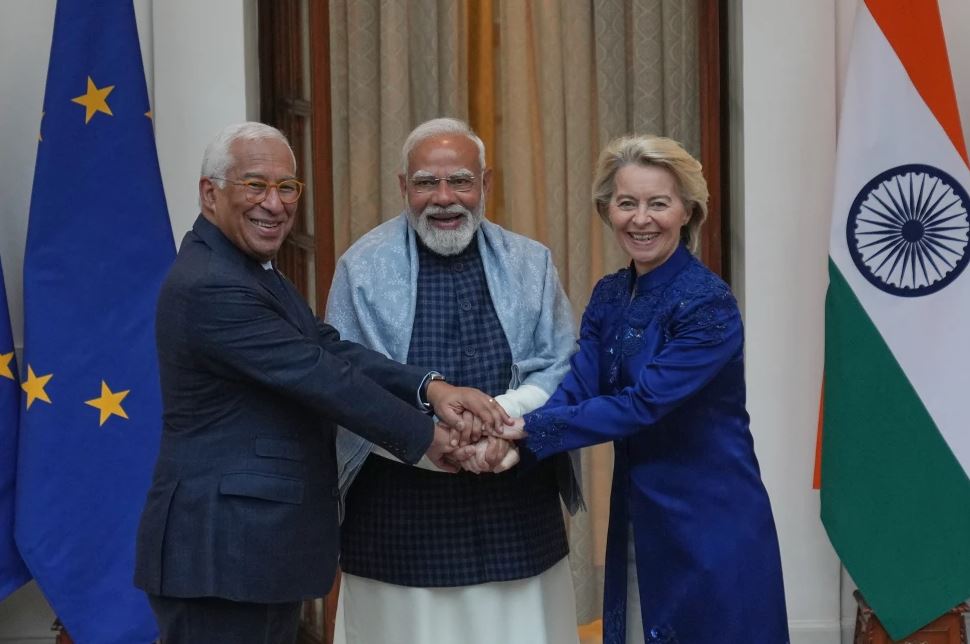
▲Photo: Collected.
The magnitude of the deal is marvelous. It is 99.5 percent of India’s trade value that prefers to receive treatment on 97 percent of EU tariff lines. The abolition of duties in the era of the labour-intensive industries is a game-changer in a country whose objectives are Viksit Bharat 2047. These industries, such as textiles, leather, gems, and jewelry, are the ones that India exports, accounting for close to 2 percent of its GDP. India is never selling its commodities by removing the tariff barriers of the Eurozone; it is exporting jobs to millions of Indians. The statistics back up the optimism. In the 2024-25 fiscal period, bilateral trade in merchandise reached its highest level, with India a net exporter to the bloc (76 billion in exports). But when we are considering the services trade, which amounts to 83 billion, we cannot do away with synergy. India is no longer the back office of the world, as it is becoming the hub of the EU’s high-tech and digital value chains, and under this FTA, access has been ensured in 144 service sub-sectors.
Why was a 20-year brewing agreement frozen in crystal at the beginning of 2026? The answer is the inhuman reality of Trade Coercion. The recent revival of America First politics and the threats of tariffs over differing territorial claims (the Greenland controversy) have shown the weakness of relying on a single transatlantic ally, the EU. In India, the risks of conventional supply chains, coupled with the otherwise high penalties on refined oil exports, have made diversification a survival requirement in the country.
India/EU is establishing a Democratic Trade Corridor through the so-called strategic decoupling of their relationship with a coercive trading environment. This kind of corridor represents an alternative to the pay-to-play, authoritarian capitalist models and the bullying of populism through transactions. It builds a system of rules in which gaining entry into the market is a right earned through joint standard-setting, not through preference. But, and here again, you will find the devil in the detail – and the detail here is standardisation. The EU is also associated with a negative image (or a reputation, again, depending on who you ask) of being very strict on Sanitary and Phytosanitary (SPS) and Technical Barriers to Trade (TBT).
The manufacturing sector, particularly the MSMEs (Micro, Small, and Medium Enterprises) in India, has a long way to go. The company will not be able to fulfill its obligations to the EU regarding its stringent health, safety, and environmental product requirements within a day. Despite the FTA providing a framework for collaboration, the Indian manufacturer must bear the burden of the so-called upgrading. The zero-duty benefit is just a theoretical victory unless a textile cluster in Tiruppur or a leather cluster in Kanpur can meet the EU’s needs under the green deal or the carbon border adjustment mechanism (CBAM).
The second success factor of this Mother of all Deals is the Indian internal regulatory environment. Despite India’s heroic efforts to liberalise its Foreign Direct Investment (FDI) in various sectors, including defense and insurance, it remains on the FDI Regulatory Restrictiveness Index list with relatively high scores. The point the European investor needs to take in stride is to bring the much-billed idea of decoupling its capital from other risky markets and investing it in the core of India, which could no longer be a slogan but something savoured. This means that streamlining approvals are done by reducing the time delay in the National Single Window System. The regulatory predictability is also important to ensure that the tax policies and investment policies remain unchanged in the middle of the game. Finally, legal vetting is allowed not as complex dispute resolution processes. This will ensure the protection of an estimated €500 million in climate-related EU support.
The India-EU FTA has turned out to be more than a trade agreement, but a revolt against the globalisation of the economy. It shows that even during the period of rising nationalism, two divergent topics can agree on an issue when strategic interests are relevant. Such an agreement with India is a calculated jump towards making it the third-largest economy on earth. It is a chance for the EU to build its Indo-Pacific policy on the stable democratic bloc of power. In the future, in 2026, the power of such a settlement will be measured not only in dollars or euros, but also in the frequency with which we will escape coercion in our supply chains and the damage we will prevent. Mother of all Deals hath been born. It is now time to work hard to make it reach its full potential.
This article was first published at Times of Bangladesh, Bangladesh, February 5, 2026,
https://tob.news/india-eu-strategic-decoupling-from-trade-coercion/.
