Can the Board of Peace Decentralise Diplomacy?
Time: 2026-01-28 Author: Sujit Kumar Datta
Last week signalled a new epoch in international relations in the cool, high air of the Swiss Alps. President Donald Trump signed the charter of the Board of Peace into existence during the daily global elites meetings at the World Economic Forum on January 22. The moment was very dramatic, as indicated by UN Security Council Resolution 2803, which was adopted following a U.S.-brokered Comprehensive Plan to End the Gaza Conflict. Promoters are celebrating that the Board is somehow bringing fresh air in the face of the slow pace of traditional multilateralism- agile evolution. Worse still, the United Kingdom and France, as the leaders of the skeptic group, herald the beginning of the end of the post-1945 world order. In the background of the polarised headlines, we must, however, ask the primary question: Can the Board of Peace actually decentralise diplomacy, or is it decentralising power under a new name, the transactional name?
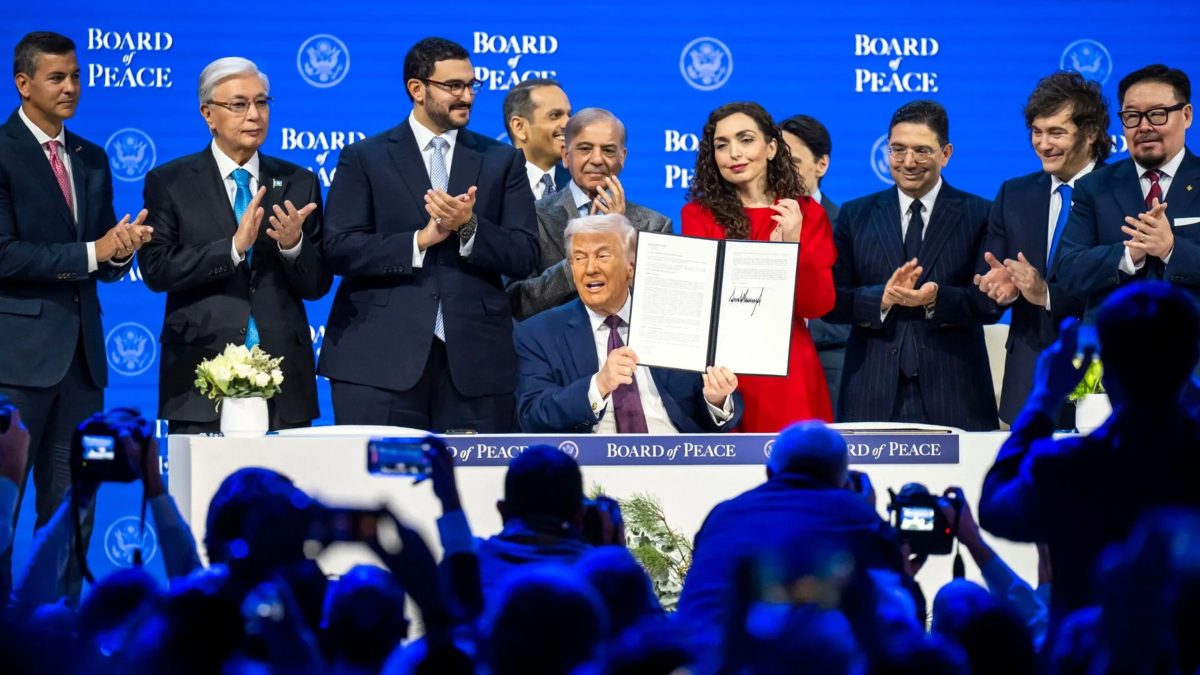
▲Photo: Collected.
The UNSC has become the emergency room of international crises over the decades, but a room where the doctors bicker as the patient bleeds. Article 51 and Chapter VII mandates have become more of a wish than a reality as a result of the stalemate among the Permanent Five (P5) members. The BoP was born from a 20-point plan to establish a new government in Gaza, which was ravaged by war and will serve as a transitional government. It is not geared toward achieving universal agreement like the UN. It is a voluntary and exclusive club of the rich. The advocates believe that redirecting reconstruction efforts out of the red tape of New York will allow the Board to introduce the lightning of the private sector into nation-building.
‘The Board of Peace does not come to argue, but to make. Red tape is going, and blue-chip results are in its place.’ – U.S. State Department Press Conference, January 2026.
The question is whether this decentralises diplomacy, and to find the answer, one should refer to the Board’s Legal DNA. It is not so parliamentary but rather a corporate board of directors:
The Chairman: It is an official position of the architect of the deal (President Trump), the final veto of any resolutions and membership.
The Permanent Seats: This will be given to states or entities that contribute a maximum of 1 billion to the reconstruction fund.
Technocratic Committee: This is a committee composed of vetted Palestinian and international professionals, tasked with municipal duties in Gaza and accountable to the Board.
To some extent, this is decentralisation. It turns the UN Plaza into an insignificant part of diplomacy, but transforms a mobile, task-oriented alliance. It replaces the sovereign equality of the General Assembly with the financial capabilities of the shareholders. It is a move towards the path of Transactional Realism within the discourse of International Relations.
Not just the alarm bells of Paris and London, but also Gaza, and the precedent. The most conservative allied countries of America, including France and the UK, have declined to participate. Their fear is twofold. First, there is Institutional Erosion. When the Board of Peace is put in place as the prime mouthpiece of the Special Economic Zone of Gaza, what will happen to UNRWA or UNDP? The BoP is jeopardising the lives of the same multilateral institutions that provide the legal and humanitarian basis of international law by channeling billions of dollars through a personal charter. Second, there is the Enforcement vs. Legitimacy. Despite the framework being adopted in Resolution 2803, the Board lacks the binding legal authority of Article 25 of the UN Charter. The Board can arrange the funding, but it cannot impose any global sanctions, and it cannot establish a peacekeeping operation with a universal law force. This constitutes a Diplomacy of Two Speeds: fast, legally superficial, and slow, legally deep.
The entry barrier of the Board is the radicalism in terms of finances. A seat at the table is also a sovereign right of traditional diplomacy. It is property to be purchased in the Board of Peace. Interest in the level of Permanent Seat has been reported in the UAE, Saudi Arabia, and Qatar, as they have come to understand that investing in the reconstruction of Gaza is also an investment in regional power. This case of the Global South is a two-edged sword. On one hand, it can raise capital that, in most instances, the UN cannot. On the other hand, it jeopardises the future of diplomacy, to which only those who can afford the buy-in can be decentralised. This trend of relying on a shareholder model of peacebuilding interests me as a specialist in International Relations, and, at the same time, terrifies me. We are just applying the buyout formula in the context of private equity in the case of a territorial dispute.
Decentralisation usually refers to the transfer of power from the top to the bottom. Nonetheless, the Board of Peace’s charter is mostly top-down. The National Committee of the Administration of Gaza is likewise technocratic and apolitical, though it is also subject to close ‘oversight and supervision’ by the Board. And can the decentralisation of diplomacy be achieved when the people of the land are not in control of the Board? When it is an American General in charge of the so-called International Stabilisation Force (ISF), and a board of foreign billionaires foots the bill, is it to Palestinian self-determination, or a 21st-century revival of the Mandate regime?
The Board of Peace is a disruptor in the purest meaning of such a word. It is a bold, yet risky, attempt to tackle a bad problem by bypassing institutions that have failed to address it in 7 decades. However, when the term decentralisation is applied to mean that the veto has been handed over to a single individual rather than a collective of five nations, it is not decentralisation, but Selective Unilateralism. An effective Board must know how to coexist with the UN’s legal legitimacy and remain effective in its own private sector. By observing the June 1 due date for the ‘Greenland Framework’ and the introduction of the ISF, we will be required to refine our analysis over the coming months. Provided the Board of Peace succeeds in transforming Gaza into the modern miracle city, as Trump claims he can, it may turn out to be the prototype of the world orders of the future. When it breaks, it might be the most expensive division of the ice of universal co-operation..
This article was first published at Times of Bangladesh, Bangladesh, January 27, 2026,
https://tob.news/can-the-board-of-peace-decentralise-diplomacy/.
