
From Melting Ice to Hard Geopolitics
Time: 2026-01-21 Author: Sujit Kumar Datta
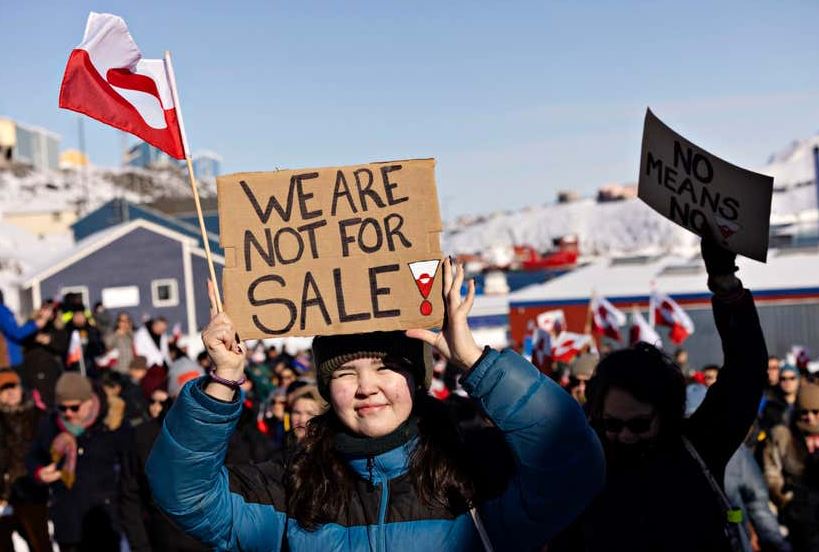
Greenland, the vast frozen island that is usually regarded as a remote backwater in the Arctic, has suddenly reappeared on the world’s geopolitical agenda. The concept of President Donald Trump purchasing Greenland has been repeated numerous times over, with the president admitting that he was fascinated with the possibility of the island being acquired either by economic coercion or even by military force, as an extension of national security in the United States, as well as to counter the growing power of China and Russia in the Arctic. This revival of interest has not been a word. U.S. Vice President JD Vance visited Greenland this year and accused Denmark of failing to do enough to protect the island. Trump also designated Louisiana Governor Jeff Landry as a special ambassador to Greenland in December, something that sent a strategic objective rather than a diplomatic interest.
▲Photo: Collected.
This interest seems confusing at first. According to the CIA World Factbook, Greenland is slightly larger than Mexico, with an area of about 2.1 million square kilometers, yet it is covered by ice. It boasts a population of under 60,000, half of Berkeley, California. Greenland is barely an economic giant internationally. It has barely diversified its economy, and it relies on its main activities, including fishing. It does not rank better than these countries in terms of GDP: Tajikistan, Suriname, Montenegro, Barbados, Aruba, and Guyana. How come the incumbent president of the U.S finds it necessary to divide diplomatic lines with Denmark and breach the time-honoured diversionary on a nation that appears to be an economic backwater?
The geopolitical positioning, natural resources, and shipping routes of the future are three interdependent factors that are exacerbated by the accelerating climate crisis and can be combined into a solution. To start with, the geography has never been out of Greenland as its most stable property. Strategically positioned between North America and Europe, the island lies over the GIUK gap, a sea passage between Greenland at one end, Iceland at the other, and the United Kingdom. This has been one of the significant components of security planning across the Atlantic, particularly during the Cold War period, when NATO relied on the passage to monitor the passage of Soviet naval forces from the Arctic to the Atlantic. The argument is equally similar today. As the Arctic melts away, Greenland will be a strategic location in controlling the entry of the North Atlantic to the Arctic Ocean and vice versa. From the U.S. military’s standpoint, control of this space enhances its early warning, missile defense, and sea surveillance, in addition to strengthening American ability to implement its eastern strategies.
In fact, the U.S. has a significant military presence at Pituffik Space Base (formerly Thule Air Base), an essential base for missile warning and space surveillance. This mark, however, is becoming too small in a new era of great-power rivalry that Washington is finding itself in. Russia has been building up its military base in the Arctic, reopening Soviet bases, and spending large sums on icebreakers and Arctic-capable forces. China, though not an Arctic state, has declared itself a near-Arctic power and has been steadily increasing its scientific, economic, and other activities in the region. It is on this basis that Trump’s demand for Greenland’s inclusion in U.S. security reflects a greater realignment of Arctic geopolitics, in other words, one that requires cooperation rather than strategic rivalry.
Second, natural resources in Greenland take on another meaning when the Arctic landscape is influenced by climate change. The potential reserves of such essential minerals lie in melting ice, as some rare earth elements, vital to recent technologies, renewable energy infrastructure, and military equipment, are present there. The availability of such minerals has ceased to be an economic issue and has become a strategic one in an increasingly securitising world. As a highly dependent country on rare earths, the United States views Greenland as a potential alternative to reduce its extreme reliance on foreign, often Chinese, sources and to promote greater strategic autonomy.
Besides minerals, oil and gas prospects are also being found in Greenland. But questions about environmental impacts and fluctuating market conditions have prevented mass production. The fact that future energy development is a possibility, however, adds to the island’s geopolitical significance. Fresh water trapped beneath Greenland’s gigantic ice sheet is another long-term strategic resource, as water is becoming a rare commodity. Even though the commercial use of this resource is not real today, its symbolic significance in the geopolitics of the climate age cannot be overestimated.
Greenland is also strategically important in Angleries. The global pattern of fishing is changing as Arctic waters warm, leading to fish stocks moving northward. Not only will the rule governing such emerging fisheries implicate food security, but also maritime jurisdiction and influence in the region. Another factor that predisposes foreigners to become more involved in the area is that fisheries already underpin Greenland’s economy.
The third one is the future of the trans-Arctic shipping. The melting ice is gradually exposing Northern Sea Routes, which could transform global trade. These sea routes along the Greenland Coastline may significantly reduce transit time between Asia and Europe or Asia and North America by bypassing the conventional bottlenecks of the Suez and Panama Canals. However, they are not very reliable year-round. As they are changing, technologies can become more trustworthy. They are made possible by advances in process warming. The person who determines the regulations, infrastructure, and security architecture of these tracks will obtain a substantial strategic advantage.
This would then be a strategic bargain in an eventual Arctic trading regime, which would pass through numerous channels, including the adaptability of warfare, economic rivalry capacity, and its own geopolitical gravitas. China finds it easy to change the Arctic ways into a Polar Silk Road notion. They also increase Russia’s desire to control the waterways in the north. Greenland, in this new competition, is nothing but a territory, and not an inactive territory, an object of policy.
Therefore, Trump is not as mad about his interest in the Greenland purchase as it might appear on the surface. It is an Arctic power decision during a time when climate change is transforming the geopolitical environment. What is vexing in such interest is manifested, however, as has been sensed, by the coercive type of rhetoric, by the appeal to the people of Denmark, by the hint of military action, and the question of what the international demands and groupings are. Greenland, for example, is a self-governing territory of the Kingdom of Denmark, and meddling with its status without the United States’ consent would signal a departure from the sovereignty principles the United States has been championing.
To the credit of the irony, what makes the process of making Greenland even more significant are also the weaknesses of small societies that are literally hunted by the great-power politics. The population of Greenland is small, and it is not economically diversified; it must withstand significant external pressure due to competition. The Greenland problem lies in how to redefine the strategic emphasis on sustainable development without losing independence or ecological integrity.
This article was first published at Times of Bangladesh, Bangladesh, January 13, 2026,
https://tob.news/from-melting-ice-to-hard-geopolitics/.
